
Honda formed its New Racing project in 1978 to return to the 500 cc world championship with a four-stroke engine. Rules allowed no more than four cylinders, while two-strokes dominated racing. Oval pistons made room for more valves per cylinder, helping the engine exchange gases at high revs.
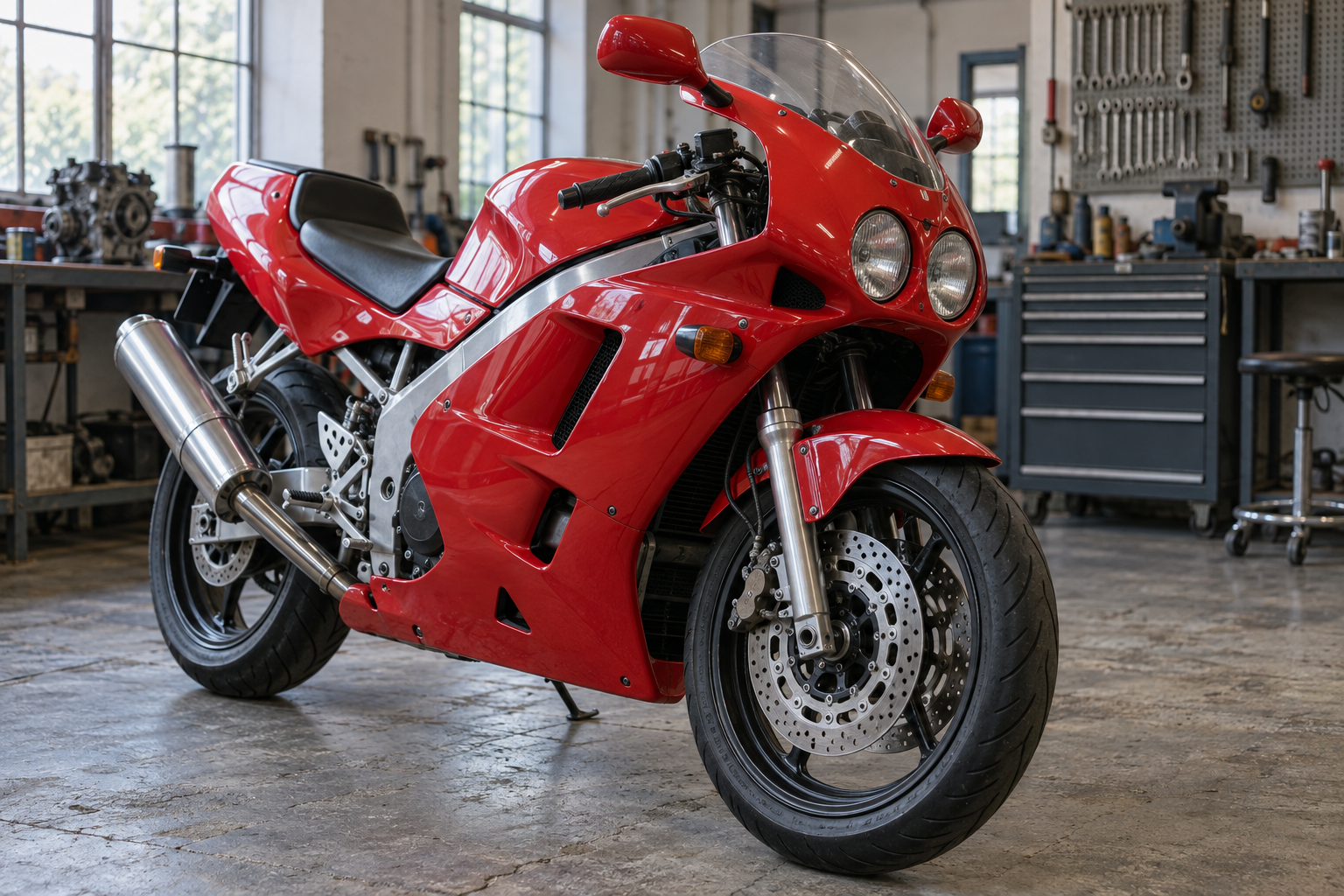
The NR500 V4 had eight valves and two connecting rods per cylinder. Its unusual shape demanded precise cylinder and piston-ring manufacturing, while twisting connecting rods presented another challenge. Both bikes retired on their 1979 Silverstone debut. By 1982, the two-stroke NS500 was taking the leading role in Honda’s Grand Prix effort.
The idea nevertheless reached the road. The 1992 NR combined a 750 cc V4 with non-circular pistons, eight valves and two spark plugs per cylinder. Its PGM-FI system used eight injectors, and its fairings incorporated carbon-fibre composite. Some of that fuel-injection and cam-drive experience subsequently informed the 1994 RVF/RC45.